AnswerThis
AI research assistant for university students and researchers — peer-reviewed source citations, literature-review matrices and an AI paper-drafting co-author.
TL;DR
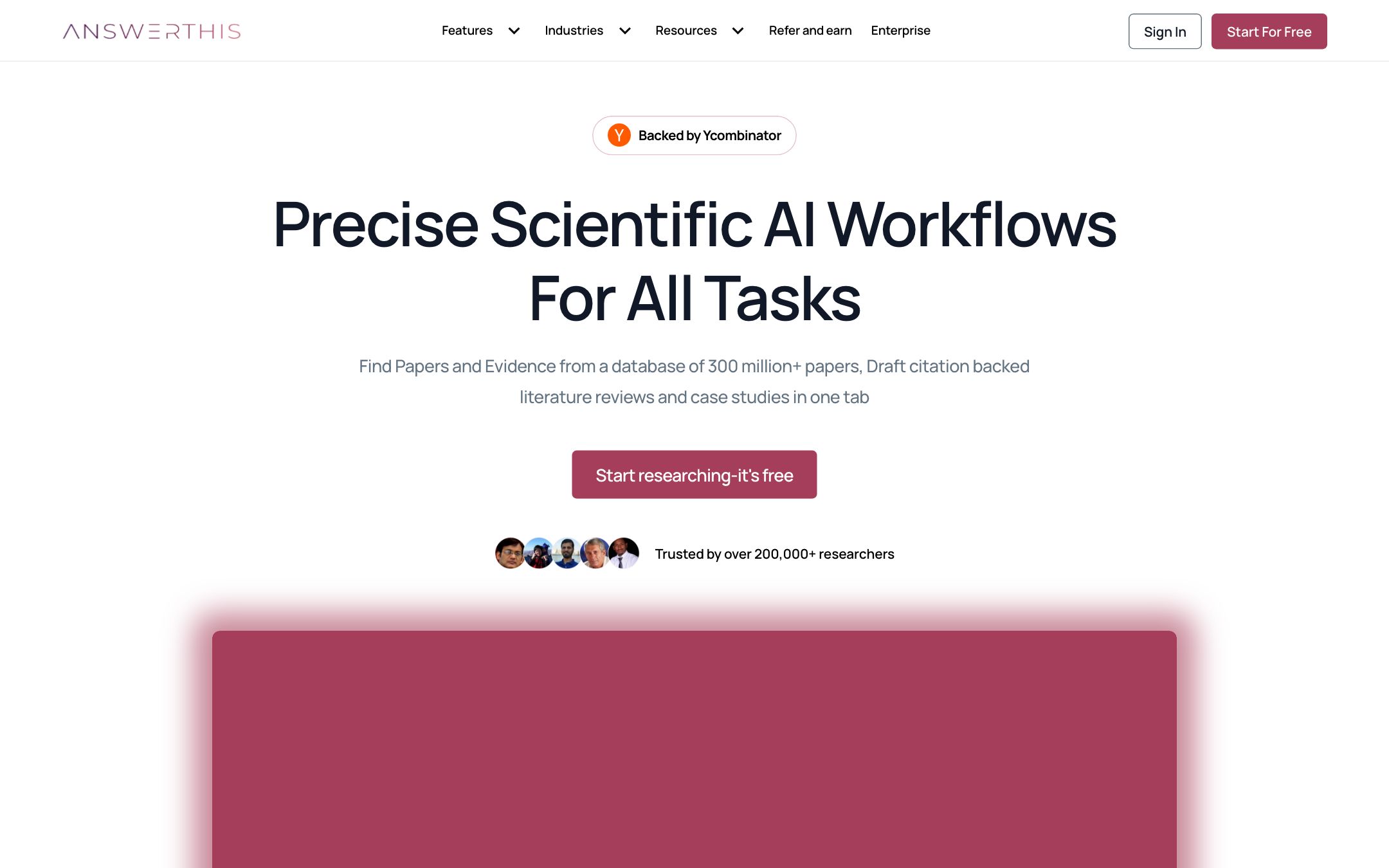
AnswerThis is a Y Combinator–backed (W24) AI research assistant aimed squarely at university students and researchers. It distinguishes itself from ChatGPT by claiming every answer is grounded in peer-reviewed sources with explicit citations. Vendor reports 200K+ active researchers and students. Best for literature reviews, paper drafting and citation-required research questions.
Recommend it if
You're a graduate student, researcher, or upper-division undergrad doing literature reviews or paper drafting; you've been using ChatGPT and getting burned by fabricated citations; or you need a citation-first AI tool that fits an academic-integrity policy that allows AI-assisted research.
Skip it if
You're K-12 (the source-quality model doesn't translate); your institution prohibits AI-assisted writing; or you need a general-purpose tutor with conversational explanations rather than research-grade citations.
Quick facts
- Platforms
- Web app
- Languages
- English (primary)
- School fit
- Higher Ed Adult / PD
- Subjects
- Research-heavy disciplines — STEMsocial scienceshumanities (with caveats)
- Time to first output
- < 5 min
- Learning curve
- Easy
- Setup
- Sign up with email; ask a research question or upload a paper to start
- Works offline
- —
Real-world use cases
How a teacher, student or parent actually puts this tool to work.
| Who | Scenario | Time | Output |
|---|---|---|---|
| Students | Grad student writing the literature-review section of their thesis — ask AnswerThis for recent work on transformer attention mechanisms; get a literature-review matrix of 12 papers with methods, findings and limitations. | 30 min | Lit-review matrix ready to paraphrase and cite |
| Students | Upper-division undergrad on a research paper — drafts a paragraph in AI Co-Author mode; AnswerThis suggests inline citations grounded in the cited paper's claims, the student verifies each. | 1-2 hr | Draft paragraph with verified citations |
| Students | Researcher checking a claim from a meeting — drops a peer-reviewed PDF into AnswerThis; asks "what's the effect size in this study and does the meta-analysis support it?" | 5 min | Answer linked to the paper's specific section |
- Students
Grad student writing the literature-review section of their thesis — ask AnswerThis for recent work on transformer attention mechanisms; get a literature-review matrix of 12 papers with methods, findings and limitations.
- Time
- 30 min
- Output
- Lit-review matrix ready to paraphrase and cite
- Students
Upper-division undergrad on a research paper — drafts a paragraph in AI Co-Author mode; AnswerThis suggests inline citations grounded in the cited paper's claims, the student verifies each.
- Time
- 1-2 hr
- Output
- Draft paragraph with verified citations
- Students
Researcher checking a claim from a meeting — drops a peer-reviewed PDF into AnswerThis; asks "what's the effect size in this study and does the meta-analysis support it?"
- Time
- 5 min
- Output
- Answer linked to the paper's specific section
AnswerThis is a Y Combinator W24 startup aimed squarely at university students and researchers. Its pitch against ChatGPT: every answer is grounded in peer-reviewed sources with explicit citations. Vendor reports 200,000+ active users.
What it actually does well
- Literature-review matrix — cross-paper synthesis (research question / methodology / findings / limitations) instead of summarizing one paper at a time
- AI Co-Author — paper drafting with inline citation suggestions
- Source grounding — each claim links to a specific peer-reviewed paper with DOI
What to watch for
- Claim-to-source drift is the modern failure mode of citation-grounded tools — the citation is real but the specific claim isn’t exactly what the paper says. Click through every citation before submission.
- Your institution’s AI policy — academic integrity rules vary widely. Read yours before using for graded work.
- Not for K-12 — the source-quality model assumes peer-reviewed research, which doesn’t map to age-appropriate research at younger grades.
What we like
- + Y Combinator backed (W24); vendor claims 200,000+ researchers and students use it
- + Pulls from peer-reviewed sources (claimed) — every claim is linked to a source citation, harder to hallucinate
- + Literature-review mode produces a structured matrix across multiple papers
- + AI Co-Author mode for paper drafting with inline citations
- + Free tier exists; built specifically for academic workflows (not a general chatbot)
Heads up
- − Citation accuracy is the make-or-break — even when sources are real, the claim-to-source mapping can drift; verify before submitting
- − Higher-ed and researcher focus — not great for K-12, where source-quality controls don't apply the same way
- − Pricing tiers and quotas not always upfront on the marketing pages
- − Heavy student use means academic-integrity policies at your institution may treat AI-assisted research differently — read your policy before submitting
Pricing breakdown
Pricing
Verified directly on the vendor site. We re-check every quarter.
Free
- · Limited research queries per month
- · Access to peer-reviewed source citations
- · Try literature-review mode
Pro
Most useful- · Higher query limits
- · Full literature-review matrix
- · AI Co-Author paper drafting
- · Priority access to newer models
Institutional
- · University-wide licenses
- · Volume pricing
- · SSO integration (typical for institutional tier; confirm with vendor)
Privacy & compliance
Privacy & compliance
What we found in the vendor's terms, DPA, and trust center. Verify with your district before deploying.
- FERPA
- Unclear
- SOC 2
- Unclear
- COPPA
- Unclear
- GDPR
- Unclear
- Trains on your data
- Unclear
- Data retention
- Not disclosed on the homepage.
- Hosting regions
- US · EU · UK · AU
AnswerThis is positioned for higher-ed / researcher use, not K-12. The vendor does not publish explicit FERPA / COPPA / SOC 2 / GDPR attestations on the public site. For institutional / university IT procurement, request the DPA + privacy statement + data-handling specifics directly. Treat the tool's source-grounding claim as a feature, not a privacy posture.
Works with
- Web (no extensions required)
- PDF upload (paper analysis)
- Export citations (typical formats — verify with vendor)
Frequently asked questions
Frequently asked questions
How accurate are the citations?
AnswerThis pulls from peer-reviewed databases and links every claim to a source. The failure mode to watch for is not fake citations (these tools have gotten much better at that) but claim-to-source drift — the source exists and is relevant, but the specific claim it's supporting isn't exactly what the paper says. Always click through to the source before submitting.
Is this allowed at my university?
Academic-integrity policies vary widely. Some universities treat AI-assisted research as a permitted research tool (like a citation manager), others treat any AI assistance in writing as misconduct, and many are still writing policy. Read your institution's policy before using it for submitted work.
How does it compare to Elicit, Consensus, or Scite?
All three are in the same space. Elicit is strongest for literature-review matrices and was an early mover. Consensus surfaces "yes/no/maybe" answers from peer-reviewed papers. Scite focuses on citation-context and whether papers cite each other supportively or critically. AnswerThis blends the literature-review matrix workflow with paper-drafting (AI Co-Author), positioning it as a fuller research workflow tool.
Does it work for K-12?
Not really. AnswerThis is built around peer-reviewed sources; K-12 research projects typically need age-appropriate sources, not the latest JAMA paper. For K-12 research, look at student-tutor tools like MagicSchool's research assistants or Khanmigo.
What does Y Combinator W24 mean?
It's the Winter 2024 batch of Y Combinator's startup accelerator. It means AnswerThis raised seed funding through YC and has been operating at a venture-scale pace for under two years — a positive signal on engineering velocity, a yellow signal on long-term stability (most early-stage startups iterate heavily or pivot).
Tags
You might also like
When to pick it
NotebookLM
★Content Creation
Google's AI research notebook — upload your sources, get briefs, study guides and audio "podcasts".
You're working with your own source set (uploaded PDFs and notes) and want a research assistant grounded in only what you uploaded.
Shepherd
Tutors & Study Companions
All-in-one AI study co-pilot for students — chat with PDFs, Notion-style notes, AI tutor, flashcards, lecture recording and an optional human-tutor marketplace.
You're a student who wants a single AI co-pilot for studying and writing — chat with PDFs, take notes, and get tutoring in one place — instead of a citation-first research tool.